
I've recently been asked to document this information, so here it is. I hope it's helpful to you. You can post a comment with your email address if you'd like me to send you a pdf version. Don't worry, I won't make your comment public! Please make comments - I'd like some feedback.
General notes:
Please note that this document has been set up only as a guideline to assist competition organisers. It is not intended as a finite document and organisers must be familiar with the current AIDA International rules, statutes, guidelines and forms to be found in the downloads/documents section on the AIDA website: www.aida-international.org Organisers should also consider local laws when organising events and investigate whether or not insurance is required. Any insurance cover must also protect officials and volunteers at the event. The organiser’s greatest priority should be to ensure the safety of all the participants, officials and volunteers at all times throughout the competition.
World record competitions require a little more organisation, further information on this can be found in the rules.
1 Decide on an organiser
I would recommend that you do not organise a Freediving competition as an individual. Organise it as a representative of an incorporated society (your club or AIDA National). In NZ this protects you and other volunteers, removing your personal liability. Stay alert and ensure that all required safety protocols are followed to avoid any claims of negligence.
Organising a competition is not difficult, there is just a process to follow. I have tried to outline the steps in this document to make it easier for you.
2 Decide on a date
Ask around your freediving buddies to find out when they are free.
Check that your competition is not overlapping with school holidays (they tend to make people busy and travel costs increase).
Check that there are no big sporting events (olypmics, world cups, etc), especially if you are expecting records to be broken, this means you are more likely to get media coverage.
Check the pool is available.
If using open water check there are no other events scheduled, eg ironman, triathlon, jet sprints, regatta.
I'd recommend starting this process at least two months before the competition so that everyone can get themselves organised and start training!
3 Read the rules
It's a good idea at this point to have a quick read through the rules to ensure you remember everything!
http://www.aida-international.org/aspportal1/scripts/aida%20regulations%20-%20v12.pdf
4 Book the pool
Consider your timetable and check the pool opening hours.
Remember that you need to allow around 15 mins to get set up at the pool. Allow 15 mins for an official's briefing and another 15 mins for the competitor's briefing. Competitiors need to check in 1 hour prior to their official top time (this should be after their briefing is finished) and need to have pool space for warm ups 45 mins prior to their top. This said, you are probably going to need to be at the pool one hour prior to warm ups so check the pool is open 1 hour before your booking. Also try to get people there early to avoid delays.
Consider how many divers you will have. I like to allow around 10-12 mins each for statics (obviously for some people we need to allow more time, eg if Guy Brew is getting in we'd probably allow at least 14 mins: start up to 30s late, 9 min breath hold, 30s for judges to assess, 1 min for congratulations and to clear the lane, 2 min countdown and a small contingency in case he smashes his record). I allow a minimum of 8 mins for each dynamic and again a little longer for the slow boys: 10-11 mins. Allowing a reasonable amount of time reduces delays through the event and gives everyone time to do their jobs without panicking.
Work out how many sessions you want. In NZ most people only like to dive once a day. If you are having 2 sessions than you might be able to make the second one a little shorter. Give divers plenty of recovery time between their dives to avoid accidents, have time to eat and allow people to perform at their best. I'd suggest a minimum of 5 hours.
Remember that you should give the judges a 10 min break every hour too.
If you have to book open water space, now is the time. Also think through your schedule. Remember it can take a minute or so for the officials to re-set the line to the correct depth after each diver.
5 Invite officials
Send around a official invitation to all the local judges, medics, helpers, etc. Outline the competition: dates, times, no of sessions, etc. Give them a date to respond by. Ask for a list of their credentials: judge level, experience, etc.
Remember that the organiser is obliged cover the costs of the officials. This includes transport, accommodation and meals.
6 Send info to AIDA National
In NZ, the AIDA NZ board does the final selection for judges for competitions. This is to ensure that all judges get to have a go at judging regularly and removes favouritism from organisers. It also ensures that there are no conflicts of interest. We attempt to have 3 judges for our competitions (rules require 2). We also generally announce men's and women's competitions separately so that we can use competing men to judge women, competing women to act as medic for the men, etc.
From the respondents of the invitation collate a list of those who would like to judge, with their credentials and send it through to the board. I would normally offer my recommendation too and any reasons why. Make sure that they get back to you quickly.
Remember that if you are expecting 50% or more international divers (eg non-Kiwis in NZ) the competition will be international as opposed to national and there is a different minimum level imposed on judges.
7 Inform officials of their selection
Confirm that the officials still want to judge, etc.
Check with their schedules and book their transport & accommodation.
Remember that if you are organising a depth event then the judges need to be available to measure the rope (in daylight) and you will probably need additional time for briefings the night before.
8 Announce the event
All competitions need to be announced to AIDA International.
Send an email to the AIDA International Sport Officer: calendar@aida-international.org
The following information should be included:
Name of competition
Competition type (eg national, world record status)
Date of competition
Place of competition
Names of judges and their levels
Organiser name and contact details
Events that will be held (eg STA, DYN, CWT)
Length of pool
Performance restrictions (eg depths limited to 90m)
The email needs to be received by the AIDA International Sport Officer at least 2 weeks prior to the event. In NZ we aim for 6 weeks.
9 Advertise the event
Let all the local club and AIDA national members know that the competition will be occurring. Send them an email or invite them on facebook. Add the event to your website. Don't forget your sponsors!
10 Ensure you have enough helpers
Check you have:
Judges
Medic and in water safety divers (remember your warm up lane/rope)
Videographer(s)
Boatsmen, time keepers, photographers, etc
Remember to cover their costs.
11 Prepare a budget
Consider your expenses:
Pool hire & entry fees
Boats (hire, fuel, etc)
Officials’ & helpers’ transport, accommodation and meal allowances
Oxygen bottle refill
AIDA International fees (2€/competition dive)
Purchase of any additional equipment (tape measure, rope, tape, tags, video cassettes, etc)
Phone calls
Insurance (if applicable)
I normally also factor in a bag of snacks for the officials (to keep them alert) and a lunch for everyone (competitors, officials and supporters) once the competition is over.
Consider how many divers you feel you can be guaranteed to participate and divide the costs, minus any sponsorship by the number of divers to find out your entry fee.
12 Prepare forms
The following should be prepared so everyone knows what to expect and to make it easy for you as the organiser on competition day:
Competition information:
Name of competition
Competition type (eg national, world record status)
Date of competition
Place of competition (include address and directions if necessary)
Any sponsors
Names of judges and their levels
Organiser name and contact details
Name of medic and their contact details
Events that will be held (eg STA, DYN, CWT) and when/where
Description of pool: length, depth, temperature, etc
Description of open water: visibility, temperature, currents, link to weather forecasts, etc
Performance restrictions (eg depths limited to 90m)
Description of any fun events outside the competition
Competition fees
Any AIDA National fees that might also be due
Link to competition rules
Schedule: Closing date for entries/payments
Times & locations for briefings/event committees (officials & competitors)
For each session: Closing times for announced performances, how & where
First check in time & where
Warm up times
First top time
Estimated finish time
Recretional events
Times & locations of social events, meetings, etc
Also include forms for participants to return:
Entry form: Name, contact details, sex, nationality
Emergency contact with relationship and contact details
Events they want to enter into
Costs involved (ie to be able to keep this form as a receipt)
Where to send forms & fees, & closing date
What to include: Medical statement & medical certificate
Liability release form
Copy of passport (if necessary)
Statement to allow club and AIDA National to utilise video/images from the event at their discretion.
Medical statement (from AIDA International website)
Liability release form
Also prepare a safety/evacuation plan. The plan will identify potential risks and how to deal with them at the specific locations involved.
13 Checklist
Write a check list for everyone and delegate tasks so everyone knows exactly what is expected of them. Follow everything up in the week prior to the competition. Re-read the competition rules to check you have not missed anything.
My checklist from a previous indoor competition looked like this:
Joy medic & media contact
alert local hospitals & pool staff: provide with safety plan
issue press releases
help set up pool during warm ups (measure, lane markers, etc) – optional
bring: t-shirt, stopwatch, tags, medical bag
Tracy head judge & jury
help set up pool during warm ups (measure, lane markers, etc)
bring: t-shirt, stopwatch, tags
John judge & jury
help set up pool during warm ups (measure, lane markers, etc)
bring: t-shirt, stopwatch, tags
Phil judge & jury (women only)
help set up pool during warm ups (measure, lane markers, etc)
bring: t-shirt, stopwatch, tag
Braedon judge & jury (men only)
help set up pool during warm ups (measure, lane markers, etc)
videographer – women, dynamic events only
bring: t-shirt, stopwatch, tags
Tammy in water safety
bring: wetsuits, fins, mask, snorkel
Sat STA
in water safety Tammy & coaches
videography Gavin
Sat DYN
in water safety Tammy
Videography Paul (men) & Braedon (women)
Sunday
in water safety Tammy
Videography ? (men) & Braedon (women)
Chris post comp draws & results on LSFC website comp page when they're ready
Jude shop for Sunday lunch & host it
Gavin bring: video camera incl cords & housing
Kathryn LSFC rep (organiser)
receive entry forms, liability releases, med certs, money
confirm pool bookings
Pick up and bring extra O2 bottle from Air Liquide, Seaview
Shopping officials’ snacks
receive nominations
compile comp draws & results
bring: O2 kit & first aid & masks
rope (starts)
lane markers & tape measure
sticky tape
rules (incl NZ)
protest forms
calculator
comp draw
competitors' forms
pens, paper & clipboard for judges
refreshments for officials
petrol vouchers for officials
briefing outlines (official time, lane set up, judges/jury, safety plan)
laptop and cords (protests)
14 Receive forms
Make sure you receive all the entry forms and payments well prior to the event so you do not have to chase anything up on the day. You might want to send a reminder email out a couple of days prior to entries closing. Chase up anything that is missing.
Let the AIDA National have a list of entrants to check they have paid their AIDA National fees.
Re-confirm your schedule and make sure you have enough pool time booked for the number of entries.
15 Receive nominations
If you are organising and competing you may need to receive nominations through a neutral party (eg a judge).
Once the closing time has passed set up the competition draw, post it on line and print copies to post at the competition site and give to judges to record results on.
The competition draw can be:
Lowest announcement first / deepest diver first
Lucky draw
The draw should include the following information filled in:
Date, name, nationality, sex, event, AP (announced performance)
There should be empty spaces for the following information to be filled in by the judges:
RP (realised performance), penalties, reason (eg black out, broke surface, late start), points, comments (eg national record, personal best).
Don’t forget your sponsors.
The draw, once filled out can then be used as the results list.
16 Competition
If you’ve done everything as noted above the competition should run pretty smoothly.
Ensure the lifeguards and the local emergency services know what you are doing and have a copy of your safety/evacuation plan, plus some understanding of the dangers of the sport.
Brief the officials, medic & helpers first to confirm they are happy with the way things will run, then brief the competitors. The briefings should at least include the following:
Thank your sponsors
Introducing the officials, organising and outlining their roles & ensuring that they have the appropriate equipment
Showing the competition draw
Where/when divers need to check in
Where/when boats will leave
Locations for warm up zones & competition zone and who is allowed to be where and when
Where photographers & supporters may and may not be
Where coaches may and may not be
Safety plan
Official time
Protest procedure
Outline of basic rules (optional)
17 End of competition
Tally up the points and have a prize giving if you have prizes.
Thank your sponsors.
Thank the officials/helpers and give them any thank you gifts, vouchers to cover costs, etc that you feel are appropriate.
Return original copies of medical certificates to the divers if you required them.
Post the results on your website/Facebook page/Deeper Blue.
Send out press releases if required.
Rest and recover!
18 Competition results
File the official competition footage somewhere safe and provide the AIDA National with a copy if they require it.
Send a copy of the results to the AIDA Nationals of all divers who broke national records.
Within two weeks of the competition ending you are required to do the following:
Send results list through to the AIDA International Sport Officer: calendar@aida-international.org
Ensure that if the judges changed from the initial competition announcement, that the correct judges are listed with the results, so that they have the competition credited to them.
Pay the AIDA international fee of 2€ per competition dive.
Wednesday, 26 May 2010
How to organise a freediving competition

While I've been home for a few months now and haven't yet found a job, I feel like I've been working full-time! The latest initiative is new pages on Facebook:
I have set up a Kathryn McPhee fan page.
You can also become a member of the group "Deep South Freedivers" to keep up to date with what I'm planning here in NZ. Check out the discussion area as I've put up a few things that might be worth you adding your 2 cents.
While you're at it, why don't you join the Lazy Seal Freediving Club group?
Sunday, 25 April 2010
Deep South Freedivers, Wanaka, New Zealand
 Learn to snorkel or take your snorkelling to a new level with Deep South Freedivers, an exciting new Wanaka based organisation fronted by world record freediver Kathryn McPhee. Kathryn offers one-off courses and regular training and coaching for novice divers in Wanaka and the Queenstown Lakes district, as well as a professional on-line remote coaching service for competitive freedivers from around the world. She also offers an exciting drift dive experience down the Clutha River.
Deep South Freedivers will also soon be offering sales of Orca wetsuits (www.orca.com for more info), streamlined lead weights and freediver's nose clips.
Please contact Kathryn directly if you would like further information about any of these services: Diving Kat Fish @ gmail.com (without the spaces!)
About freediving:
Freediving is often referred to as extreme snorkelling, however is really just the breath-hold part of snorkelling. It is a sport that is accessible to people of all ages and backgrounds, as minimal equipment is required; you just need water and a little willpower.
Learning to freedive opens up the underwater world to you for spearfishing, hunting & gathering, photography, and general scenic discovery. It is the best way to view coral reefs on your Pacific island holidays and is excellent for low impact general fitness.
Freediving is also a competitive sport. Competitive freedivers test the limits of their abilities in events based on time and distance in the pool and depth in open water. The world’s best are diving to depths greater than 120m and have static breath holds up to 11 minutes. Competitive freediving is as much a psychological game as it is physical. It is demanding and relaxing, frightening and peaceful. In 2008 New Zealand had four freedivers with world number one rankings!
Freediving can be dangerous. Always ensure adequate training and safety. We recommend participating in a course to test your limits, learn of the dangers, how to stay safe and how to assist your buddy if required. Never dive alone and ensure that your buddy is trained to assist you should you need help.
About Wanaka:
Wanaka is one of the most spectacular locations in an already incredibly beautiful country. The town of Wanaka sits on the edge of Lake Wanaka in Central Otago, a southern region of New Zealand’s South Island. It is surrounded by stunning mountains providing scenic hiking and mountain biking tracks as well as world class ski-fields in winter. The lake is easily accessible providing extremely deep and clear water to dive in.

About Kathryn McPhee:
Kathryn has been freediving since 2004. She has gradually worked her way up from absolute beginner to one of the world’s best. She has held a multitude of New Zealand and Oceanic records in all six competition events. In 2008 and 2009 she set four unofficial and one official world record in the distance based pool event of Dynamic without fins, swimming underwater breaststroke 159m on a single breath. She was published in the 2010 Guinness Book of World Records. At the 2009 indoor world championships in Denmark she won medals in all three events. Kathryn was voted “World’s best female freediver of 2008” in the ICARE awards. She has a breath hold of just over 7 minutes and has dived to a depth of 65m.

Kathryn ran the very successful Lazy Seal Freediving Club in Wellington from 2005 to 2009. There she taught most of the new members to dive and helped with coaching of the more serious divers. She has offered her remote coaching service since 2008 and has had successes with all students achieving personal bests and one even winning gold at the world championships in Denmark.
Kathryn is excited about bringing the sport of freediving to Wanaka and encourages you to make contact if you are interested in learning more about the sport, regardless of your background or ability.
Saturday, 3 April 2010
Blanket

Now the biscuits have all been devoured but I’m still inspired to add to the blanket. I feel that the now large part of my life as a competitive freediver is under represented in the blanket. I’m currently looking to set up my own small freediving school here in Wanaka and I’m hoping to have some very personal badges made up and am keen to stitch one on very soon.
If anyone feels they would like to be represented on my blanket, or has a patch that might be relevant, please feel free to post it to me - I’d greatly appreciate it!
South American adventures


They have an interesting and diverse culture and landscape, and again it is mostly pretty high altitude. The highlight of Bolivia was visiting the Uyuni Salt Flats. We took a three day 4WD tour through the “white desert”. It was the rainy season and there was no wind so the salt had a film over water over it that clearly reflected the cloud formations – absolutely stunning. They also took us past colourful lakes full of flamingos, active thermal areas with geysers and hot pools, llamas made of salt, strangely shaped boulders, local villages, warm hotels fabricated from salt bricks and small bright green oasis’s in the midst of yellow desert. It was huge, diverse, strange and beautiful. The 4WD vehicles on the other hand were made for very small people with short to no legs and big soft cushioning bottoms. There were no toilet facilities (and if there were you were probably better not to use them) and the roads are incredibly rough (that’s normal in Bolivia unless there’s a mine nearby).


Monday, 30 November 2009
World Champs, Bahamas

Fortunately Dean's blue hole was just going through it's morning high tide phase while we were training and conditions have improved immensely for the competition. I arrived a little over two weeks ahead of the world champs to ensure some time to adjust to the hole and recover from jet lag. My training was going pretty well. Initially I felt some fatigue during dives, which was to be expected, but I was still going fairly deep without squeezing or packing. I had a few issues getting my head around using my monofin, but managed to get back to my personal best after a couple of attempts. I was diving happily and not squeezing.

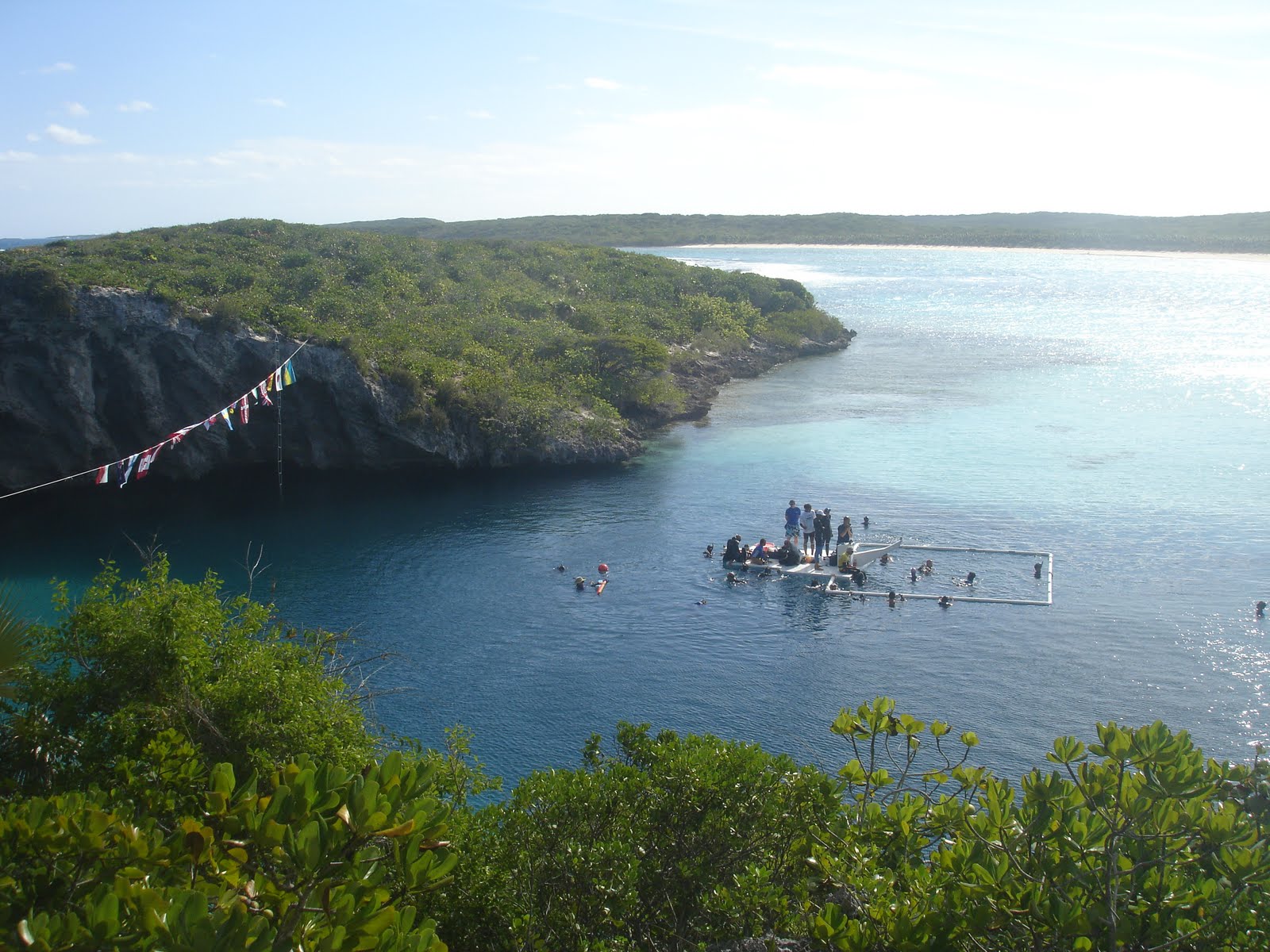
Update from following day:
Lung Squeeze clarified
Lung squeeze is a shy topic among freedivers. There is very little information available either in books or on the internet and little scientific research seems to have been undertaken, as if it is a rare and uncommon problem. However, when asking around it seems most freedivers have suffered from it at some point in their diving careers, coughing up varying amounts of blood. Some continue diving and seem to get over it. For others it never goes away and they eventually retire from deep freediving with great frustration. Not coming from a scientific background, I struggled to find good explanations describing what happens and why and still am failing miserably to solve the problem despite giving myself time to try many different things that have worked for other people. I am also slowly learning from my mistakes. Here is some information that will hopefully help others to avoid what I have been experiencing.
You do not have to be a particularly deep diver to experience lung squeeze. I have heard of divers experiencing squeezes after dives as shallow as 4m (in a swimming pool), especially if they are diving on FRC, negatives or passive inhales. You do not actually have to cough up blood to be suffering from a lung squeeze. You may just be able to feel a little bit of fluid in your lungs after a dive and take a while to recover while breathing heavily. If you continue to dive after this then you will most likely make it worse and end up coughing up blood, requiring a longer time to recover.
There are two things that can happen. The first is that as you reach residual volume (the volume of air remaining in your lungs once you have fully exhaled) the negative pressure in the lungs will cause the lung walls to stick together and cause damage as they peel apart (essentially grazing the inside of your lungs) and the blood vessels can swell up and burst, causing bleeding inside the lungs (pulmonary edema). This creates a cough reaction to remove the fluid (blood) from the lungs. The likelihood of this happening is increased by diving deeper than your residual volume, the occurrence of contractions at depth or the use of the valsalva method of equalisation (pushing air directly from your lungs to equalise your ears), all of which create a huge negative pressure within the lungs and tension on the chest. Once a squeeze has occurred there will be scarring on the lung tissue and the chance of it happening again is greatly increased over the next few days and possibly weeks.
Other factors that could contribute to a squeeze are fatigue, discomfort and fear, tension or lack of flexibility through the chest/ribcage, or lack of elasticity in the lungs, which seems to be the case with a lot of pool divers who have stretched out their lung with a lot of packing. Over hydration can be a factor in blood spitting as there is already more fluid around the lungs which may not be retracted into the body after blood shift, however dehydration can make equalisation more difficult and cause the diver to tense up the chest area. Jet lag can make “easy” dives very uncomfortable and tiring. Careful adaption dives are fine while the body is jet-lagged however deeper dives should be delayed until the body has recovered. A general rule is that jet lag, whether you consciously feel it or not, lasts about one day for every hour difference.
There may be more blood if the squeeze occurs near a capillary where there is more blood available, so the quanity of blood is not a good indication of the severity of the squeeze. There may be a lot of pain or no pain at all depending on where the squeeze occurs, as there are no nerve endings in the lungs.
Trachea squeeze should also be noted. Sometimes divers come up with a sore throat and spit a little blood, usually just a small amount and only once. This is often after looking down at down at depth and creating a negative pressure in the incompressible and delicate trachea, which can also result in burst capillaries. It is possible to increase the flexibility of the trachea to avoid this.
The second issue is the potential for over pressurisation of the lungs (pulmonary barotrauma) on the ascent once bloodshift has occurred, which would suggest that full packing for deep diving is problematic. A freediver who packs on the surface will use a little air in equalisation and metabolism during the dive, however the overall quantity of air in the lungs does not decrease a great deal for the ascent. If there is blood remaining in the lung capillaries from the blood shift then there is again the potential for the already swollen blood vessels in the lungs to rupture near the surface and the diver experiences overpressure. Barotrauma is normally identified by foamy blood.
Lung squeeze can be serious. If your lungs are full of fluid, the alveoli are not able to pick up the oxygen from your lungs to transport it through your body to where it is needed for metabolism. Your oxygen saturation levels are low and can remain that way for a long time. In an extreme case this can cause secondary drowning. If it occurs at sea you may not be physically capable of swimming back to shore or the boat. You may not have the energy to remove your wetsuit or walk to the car. Fatigue and wheezing from serious squeezes have been reported to last up to a month in extreme cases.
Remember to always dive “one up, one down” with your buddy and ensure that they understand the potential dangers of squeeze. I often black out when I suffer a lung squeeze, even if the dive is much shallower than what I am usually capable of. My body is unable to absorb the remaining oxygen in my lungs to complete the dive and it is slow to recover when I begin breathing on the surface.
To try to avoid lung squeeze you should consider the following:
- Avoid stretching out at depth with arms or neck. This includes looking downwards, taking large strokes/pulls at depth and swimming or freefalling with arms stretched above your head.
- Try warming up if this reduces your contractions at depth
- Work on your ribcage flexibility and stretch this area before diving deep
- Turn before you experience contractions at depth
- Progress slowly each time you start diving to depth
- Avoid deep dives after travelling, especially if you have changed time zone or feel tired. Allow time to recover from jet lag prior to competing.
- Only dive as deep as you are comfortable with to avoid panic at depth
- Learn to relax at depth and release any tension from around the chest area prior to going to great depths. This can include tension from equalisation and learning to just keep the eustation tubes open during mouthfill equalisation may help or finding a very relaxed and streamlined body position that suits you.
- Learn the frenzel/mouthfill technique of equalisation
- If you are warming up and can feel the previous squeeze, do not continue with your deep dive
- If you have a history of squeezes, in competition nominate depths much less than the sucessful (no squeeze) dives you have completed in training and do not try for a personal best in the 3-4 days before
- If you have a history of squeezes, rest the day after a deep dive (even if you do not squeeze) as the potential for squeezing the second day seems to increase even if the second dive is much shallower.
- Maintain regular depth training sessions, even in the off season
- Start exhaling just before the surface (however this should be practised in a controlled environment)
If lung squeeze occurs you should:
- Stop diving and exit the water
- Stop any physical activity. Ask your buddy to tow you to shore and carry your equipment
- Breathe pure medical oxygen, if available
- Seek medical advice promptly, preferably from a designated dive doctor. They will quite likely give you some antibiotics to ensure you do not get a lung infection or pneumonia
- Drink plenty of fluids
- Take iron and vitamin C to help repair and reduce risk of colds
- Rest at least for several days before diving or putting any pressure on the lungs
travels cont...
After my final lung squeeze in Dahab (a fairly decent one), I decided to spend my last week not doing any deep diving and instead finally do what I'd planned to the whole time but had been rather distracted from and spend some time relaxing and playing with fish. I managed to persuade buddies to come with me to some of the local dive spots to finally get a feel for the place outside the big hole.
I discovered the timid little eels at eel garden. It was a bit of a cheap thrill. You have to practise very quiet duck dives to get down there before they notice you and become shy, retreating back under the sand. While out of the sand they just look like grass really, so not particularly stimulating. However the dive spot was quite pretty with lots of fish and colourful coral.
Wendy came with me to the Caves which boasted some interesting lighting effects for photography and had a couple of moments of pretty coral. The caves actually went back in under the beach which was quite odd. There was a curious barracuda and some Russian mermaids.
Lighthouse (aka Light Howse) was full of incompetent scuba divers doing intro dives with dive masters swimming above them holding their tanks. It's actually quite scary to watch them as they have absolutely no idea what they are doing.
Wendy and I also dived the canyon. I'm absolutely scared of doing swim throughs. It really doesn't matter what depth they are. Fortunately we had a brilliant day. The sun was shining, although that's really a given for Egypt, there was no wind whatsoever and the sea was so flat it was reflective. We struggled to find the canyon after poorly selecting and following some random scuba divers who strangely enough obviously did not intend to dive the canyon despite diving at the site. The surround area is fairly dead an uninspiring so I don't know what they were thinking. Eventually we found the big split in the rock below us. It was 18m under and we could see it perfectly from the surface. The part of the canyon that we managed to have the nerve to swim through is about 25m deep and roughly 10m long. Being me, I completely screwed it up. I swam very close to the bottom worrying about hitting my head so was 28m under. I'm used to dynamics so started swimming along and hit the end. Now instead of then swimming up I looked up and couldn't see the hole to get out, thought I hadn't gone far enough (but had actually gone a little too far) and that I just couldn't see clearly (my eyes are useless and it was a little dark), so I turned around and went back the way I came. Luckily Wendy recorded the evidence on video so my stupidity can be retained for all eternity. I then had to do it again properly and almost did the same thing again, but I'm pleased to say I did manage to do it sucessfully eventually! There was some nice coral nearer the shore where we were a bit out of the way from where the destructive scuba divers would swim to. Wendy and I agreed that coral and goldfish get a bit boring though.
I'm proud to say I made it out of Egypt without really getting sick. OK, I did have 8 hours of fever and headache, but it made me stay in bed (note bedroom, not bathroom) for my rest day, so it wasn't all that bad. Patti managed to accidentally drink some fresh nile water and not get sick, which was just as well since she was on a feluca, which tend to not have toilets.
My last week in Dahab was a bit up in the air. I didn't know when I was leaving as my flight from Cairo to Madrid was cancelled and I'd been moved to the next day, which was just one of the worst things in my world at the time as it would leave me with only one day in the western world prior to entering back into another backward sandy place. Plus there is too much fantastic art in Madrid to get around it all in a single day. Fortunately my travel agent managed to get me out of Egypt earlier rather than later and I was saved with three days in wonderful Madrid. I'm still unsure if Madrid was so wonderful due to the contrast with Dahab or because it's actually a fabulous place. I arrived at about 4am and got ripped off by a taxi driver who I didn't have the willpower to fight with and I didn't think my 2 Spanish lessons (one done in the airport in Cairo late at night) would help me much for this argument. Once the hostel owner had figured out who I was and actually let me in and I'd climbed the three flights of stairs with my 40kg of gear I went to sleep and managed to sleep right through the changing of the guard at the royal palace, which is special because it only occurs on the first Wednesday of each month, while I happened to be there, sleeping obliviously through the whole thing.
I had great plans for my extra day in Madrid including some me time and pampering (I'm in desperate need of some work on my hair and unfortunately still am). Anyway, I ended up spending three days walking all over Madrid, truly exhausting myself with no time to stop at all. Madrid is a beautiful city with a lot of interesting history. I did a couple of walking tours of the city (the centre isn't all that big, similar size to Wellington). I visited the palace which has a very awesome armoury. I got my Picasso fix for the year at the Museo Reina Sofia. I saw so many of the masterpieces I studied in art history at uni at the Prado. I visited the Caixa Centre, a hovering brick building by reknowned architects Herzog & de Meuron. I went to the compulsory tourist flamenco dance show. Plus I visited a few other galleries that seemed significant. As I was on my own I took up a challenge I found at the tourist information centre to take snapshot photos of a list of random monuments around Madrid. Being me I took it to heart and did both of the tours on offer and saw a few more things than I would have otherwise and ended up walking all over Madrid and exhausting myself a little more. They gave me a couple of free gawdy t-shirts in the wrong sizes for my efforts (more stuff to carry). I wish I'd had a few more days there, but definitely intend to head back to Spain at some stage in the future.
After just about killing myself carrying my gear back down the stairs, up the road to the subway, through the very narrow entry onto a train, up and down some stairs, onto another train, then yet another walk and another train I made it to the airport, which is new and very flash and thankfully, where there are trolleys. It was designed by Foster and Partners (the airport, not the trolley) which unfortunately has nothing to do with the firm I work for (Foster Architects – Ang and me vs Sir Norman with his hundreds of staff in offices around the world). After surviving the first of many interrogations (because I was flying to the USA and EVERYONE now wants to bomb them because Americans are just so annoying) I was hoping there would be some shops where I could buy some nice Spanish couture with my remaining 20 euro, but I was departing from a satelite terminal which was much less exciting and only gave me boring chocolate and alcohol options. Neither of which are particularly condusive to freediving training, yet everyone knows that freedivers consume vast quantities of preferably dark chocolate while no one is watching – full of anti-oxidants – we ignore the fat. Most freedivers could do with a bit of fattening up anyway, then they'd stop complaining about how cold it is when the water is “only” 26 degrees. We're lucky to have air warmer than that in New Zealand.
After my three days in Madrid I was already suffering water withdrawals and despite immense fatigue I managed a swim, spa and bath in my flash airport hotel in Miami before passing out.
Thursday, 29 October 2009
Dahab
Things I love about Dahab:
the blue hole
the water (Red Sea)
the fish
the men love me (blue eyes)
the heat
the sunset
the stars
NZ$0.75 ice creams (think Trumpet)
camel-jambs (I actually saw a real traffic-jamb involving only cars the other day)


Things I hate about Dahab:
the smell (think open sewers)
the water (brown & bacteria ridden)
the inconsistent & unpredictable bodily functions
the rubbish (everywhere)
the dust
the dirty feet
the incompetent snorkellers (how to destroy an ancient coral reef with several easy steps: walk on it)
the men love me (for all the wrong reasons)
the heat
90% of local men
“buy one”
“taxi?” (if they haven't run you down getting to you first)
compulsory prayers (mosques with loudspeakers), especially the 4am version
“Dahab time” juxtaposed with big city impatience (maybe this should be teamed up with the “90% of local men” and their general arogance)
the smokers (again maybe this should be teamed up with the “90% of local men” and their general arogance)
Saturday, 10 October 2009
Freediving in Egypt
Training in Dahab has been a bit average to date. I've had a lot of issues with equipment but have managed to replace, find or repair everything, so it's not the end of the world. I've been slowly working through my panic at depth issues and finally it all seems to be coming together. I've had further problems with small squeezes, not necessarily coughing blood, but just feeling like there is a little fluid in my lungs. I think I might have always had this but wasn't aware of it as I am now. I'm very flexible through my chest but it's the panic that makes me tense up. I've started setting my dive alarm at a “safe” depth so if I'm having trouble relaxing that's about when I should turn back, but I still get a decent dive in, if I'm relaxed I continue onward. It's improving gradually and I've had some very nice relaxed constant no fins dives between 45 and 50m and down around 60 with my monofin. The large contractions are now subsiding too which is a relief. Once I've done a few more comfortable ones then I'll start to work on increasing the depth slowly. The Blue Hole is wonderful to dive in. It's a short swim out and so sheltered. I can look at the wall on the way down to distract myself. The dives are becoming more natural and I don't have to focus quite as hard to keep everything together.
I spent 10 days in Sharm el Shiekh diving with the Russians and Bill and living in total luxury in a hotel where I had a whole huge room to myself (first time since I stayed with Elisabeth in Aarhus in early August) and they had buffet meals three times a day so I could just relax and do nothing. I actually got bored when I finished my book.
I messed around with doing warm ups for a week but they really didn't work for me. I didn't get enough time between the dives to reach the total relaxation state I like to achieve before my dives and as I struggle psychologically it is easier to just keep the focus and relaxation of a single dive rather than four. There was a competition at the end and it was a pleasure to witness Natalia doing her very clean new world records in constant weight and free immersion. It was also nice to get to know her a bit better. She is a very shy, creative and intelligent woman who writes her freediving blog in the form of poetry (only in Russian unfortunately), setting some of her poems to music and video to share the beauty of freediving with a wider audience. I think she has struggled with the depths too, though you wouldn't believe it now. I didn't really feel ready for the competition, but managed to do a couple of very relaxed and enjoyable constant weight dives to 52m and 61m (dive time 2:02). It wasn't a personal best, but I had plenty of air left and it was one of the nicest feeling deep dives I've done, which is an achievement in itself as that was one of my main goals for my time in Egypt.

